I have watched both The Godfather Part I and The Godfather Part II, and I have also read Mario Puzo’s The Godfather in its entirety. Each of these experiences was more than just entertainment for me; it felt as though I had entered a realm where every glance, every silence, and every word carried a weight capable of changing destinies.
Admiring a Cinematic and Literary Masterpiece
The Godfather is not merely a film or a novel—it is a modern legend whose heroes and antiheroes walk the narrow line between humanity and ruthlessness. Coppola, with the patience of an Italian architect, constructs each scene with precision; the light filtering through a window, the angle of a table, or even a pause before a line is spoken—all are part of the architecture of this world.
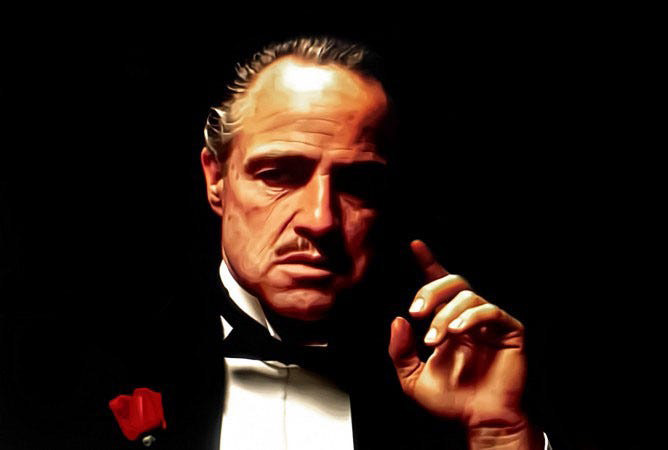
Marlon Brando, as Don Vito Corleone, creates a presence whose calm is more terrifying than any shout, and Al Pacino, through his journey from innocence to the coldness of steel, embodies the quiet and creeping nature of corruption. Nino Rota’s music acts like an invisible thread, weaving all these elements together, while Mario Puzo’s novel reveals layers the cinema inevitably had to leave behind.
The Corleones’ Philosophy and Its Connection to the Real World
On the surface, the world of the Corleones is that of the Mafia. But look deeper, and it becomes a metaphor for human society itself. In this world, justice is a relative term, and truth is often buried under layers of self-interest. The Mafia is not just a criminal organization—it is a stripped-down, unmasked version of the same power games that operate in politics, business, and even our daily relationships.
The Godfather shows that:
- Power is not gained through violence alone, but through a combination of trust, fear, and respect.
- Family can be both a refuge and a battlefield.
- Absolute loyalty is either the greatest asset or the most dangerous chain.
This story teaches us that behind every deal, every smile, and even every handshake, there is a plan.
From a philosophical perspective, the Corleones represent a kind of in-group morality—a code in which ethics and law matter only as long as they serve to protect the family’s safety and interests. This brutally honest outlook reveals an uncomfortable truth: in the real world, many political, economic, and even personal decisions are shaped in the same way—only dressed in more civilized appearances.
In the end, The Godfather leaves us with a question each of us must answer for ourselves:
In a world where everyone is fighting to survive, is it possible to remain powerful and still remain human?
How the Corleones Differ from Other Families
What sets the Corleones apart from other Mafia families is their approach to power and legitimacy. Most families rule through naked fear and blatant violence; they see bullets and bloodshed as the primary language of power. The Corleones, however, view this language as the last resort, not the first.
Don Vito, unlike many of his rivals, seeks to wrap power in a veil of respect, reciprocity, and service. He understands that lasting power comes from a fear blended with respect, not from reckless terror.
While other families want to be rulers, the Corleones want to be accepted—unquestionably—as a necessary part of the social order, even if that order exists in the shadows.
This difference draws them closer to the broader realities of the world: in politics, economics, and even culture, the most enduring powers are those that present themselves as part of the system, not its enemy. Through this method, the Corleones evolve from a Mafia family into an unofficial yet legitimate institution—something many real-world powers, governmental or otherwise, strive to become.