One of the most important questions to ask yourself at the beginning of your programming journey is: Do I really enjoy this path?
Understanding your passion is the first step toward success in any field, and in programming, this becomes even more crucial. Unlike the glamorous image sometimes portrayed on social media, programming isn’t always fun. You might spend hours stuck on a bug or a seemingly simple structure that actually demands deep focus, patience, and analytical thinking to resolve.
How Much Does a Computer Understand? Almost Nothing.
A computer is an incredibly fast but not very intelligent machine. It has zero understanding of “meaning.” For example, if you tell a human:
“Go get the cake from the fridge. It’s on the lower shelf.”
They will, using prior knowledge and life experience, figure out:
- Where the fridge is
- How to open it
- What “lower shelf” means
- What a cake is and how to find it
But for a computer, none of this is obvious. You have to spell everything out clearly, step by step, with zero ambiguity.
Programming is exactly that: converting human logic into precise, unambiguous instructions a machine without understanding can follow.
Programming Boils Down to Three Concepts
Despite the evolution of programming languages over the decades, all programming is fundamentally built on just three core concepts:
- Sequence
- Condition
- Loop
All complex software structures are composed using these simple ideas. The real skill of a programmer lies in using these tools to translate real-world logic into executable code.
Start with Algorithms, Not Programming Languages
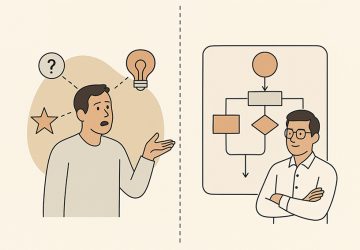
Before diving into Python, JavaScript, or any other language, you should first learn algorithm design and flowcharts.
Algorithmic thinking means being able to break down a problem into step-by-step instructions that a machine can understand.
This skill is the foundation of your entire programming career.
If you enjoy this stage and feel that your brain clicks with this kind of thinking, then it’s time to pick a popular language like Python, JavaScript, or even C++, and start translating those algorithms into actual code.
What to Do After Learning a Language?
At this point, many specialized paths open up to you:
- Web development (Frontend or Backend)
- Mobile development (Android/iOS)
- Systems and hardware programming
- Artificial Intelligence and Machine Learning
- Game development
- Embedded systems
- Data analysis and Data Science
- Automation and DevOps
Each of these areas has countless free and paid resources. So please:
Instead of paying for expensive, time-consuming classes, learn how to search effectively and use online resources.
Effective search skills are one of the most important abilities of a professional programmer.
Today, with tools like ChatGPT, no question should go unanswered—if you know how to ask it right.
What Separates a Pro from a Beginner?
Beginners just want the code to “work.”
Professionals go beyond that:
- Is my code readable?
- Is it easy to maintain and extend?
- Is the architecture clean and scalable?
- Can someone else understand my intent from the code?
- Is it testable?
- Does it follow engineering standards?
When you start to care not just about results but about process, structure, and code quality, you can confidently say:
I’m not just a programmer. I’m a software engineer.
Do You Need a University Degree to Become a Programmer?
The reality is:
- No, you don’t need a degree to become a programmer.
- Most top tech companies (Google, Apple, Microsoft, etc.) have dropped degree requirements.
- What matters most: skills, portfolio, and problem-solving ability.
But that’s not the full picture.
Computer science knowledge like:
- Data structures
- Algorithms
- Core concepts like CPU, RAM, code execution, memory models
Can elevate you from just a coder to a true engineer.
This knowledge can come from a university or online platforms like Coursera, Udacity, or local platforms such as Faradars.
Summary
To summarize the journey of becoming a professional programmer:
- Assess your passion for problem-solving and logical thinking
- Learn the fundamentals of algorithms and flowcharts
- Pick a programming language and translate logic into code
- Enter a specialized domain of interest
- Practice through projects, challenges, and building a portfolio
- Continuously learn core computer science concepts
- Focus on code quality, software architecture, and engineering standards
And most importantly:
A professional programmer is someone who never stops learning.